
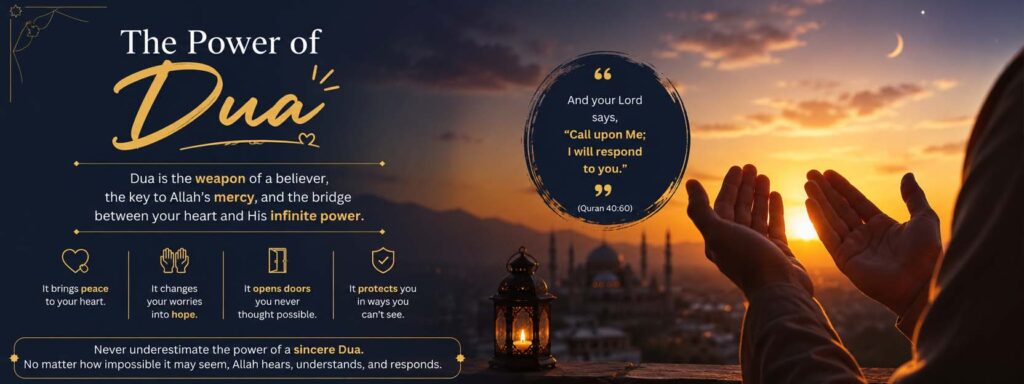
The Power of Dua: Your Direct Connection to Allah ﷻ
A comprehensive, Quran- and Hadith-backed guide to the most powerful act of worship available to every believer — at every moment.
Imagine having a direct, open line of communication to the Creator of the universe — no intermediary, no waiting, no rejection. This is not wishful thinking. This is Dua. In Islam, Dua (دعاء) — supplication — is the most intimate act of worship a believer can perform. It is a private conversation between a servant and his Lord, backed by a divine promise of response.
This article explores the power of Dua from every angle: its definition, its Quranic foundation, its Prophetic endorsement, its etiquette, its barriers, and the extraordinary ways it can transform your life — backed by authentic references from the Quran and Hadith.
1. What Is Dua?
The Arabic word “Dua” (دُعَاء) comes from the root verb “da’a” (دَعَا), meaning “to call” or “to invoke.” In Islamic terminology, Dua is the act of calling upon Allah with humility, hope, and sincerity — asking Him for anything from the highest stations of Paradise to the most ordinary needs of daily life.
Dua is not merely prayer in the ritualistic sense. It is a conscious act of acknowledging Allah’s lordship and your own need. Every time you raise your hands and call on Allah, you are declaring with your entire being: “I am weak. You are All-Powerful. I need You.”
- Dua is worship (ibadah) — not just a request, but an act of submission
- Dua has no restrictions — any language, any time, any posture
- Dua is personal — it is your own words to your own Lord
- Dua is universal — every prophet from Adam to Muhammad ﷺ made Dua
- Dua is continuous — there is no limit to how often you can ask
2. Why Dua Is the Most Powerful Act of Worship
“Dua is worship (al-ibadah).”
— Prophet Muhammad ﷺ | Sunan Abu Dawud 1479, Tirmidhi 3247 (Sahih)
This single Hadith elevates Dua beyond anything most of us imagine. It is not a wish. It is not a last resort. It is worship — ranking alongside salah, fasting, and dhikr as a direct path to closeness with Allah.
The Prophet ﷺ also said:
“Nothing repels divine decree (qadar) except Dua, and nothing increases one’s lifespan except righteous deeds.”
— Tirmidhi 2139 (Hasan)
This is a profound statement: Dua is the only force in creation that can alter destiny. It does not override Allah’s will — it IS part of Allah’s will. He wrote your Dua and its effect into your qadar before you were born.
“The weapon of the believer is Dua.”
— Al-Hakim, Al-Mustadrak | Prophet Muhammad ﷺ
3. Quranic Proof of the Power of Dua
The Quran contains numerous verses about Dua — Allah’s direct invitation to call upon Him, His promise of response, and living examples from the lives of His prophets. Here are the most powerful:
Allah’s Promise to Answer
وَقَالَ رَبُّكُمُ ادْعُونِي أَسْتَجِبْ لَكُمْ
“And your Lord says: Call upon Me; I will respond to you. Indeed, those who disdain My worship will enter Hell rendered contemptible.”
— Surah Ghafir (40:60)
This verse contains an unconditional promise. Allah does not say “I might respond” or “I will respond if conditions are met.” He says: Call upon Me — I will respond. This is a divine guarantee.
Allah Is Near
وَإِذَا سَأَلَكَ عِبَادِي عَنِّي فَإِنِّي قَرِيبٌ ۖ أُجِيبُ دَعْوَةَ الدَّاعِ إِذَا دَعَانِ
“And when My servants ask you concerning Me — indeed I am near. I respond to the invocation of the supplicant when he calls upon Me.”
— Surah Al-Baqarah (2:186)
Dua of the Prophets in the Quran
رَبِّ هَبْ لِي مِنَ الصَّالِحِينَ
“My Lord, grant me [a child] from among the righteous.” — Dua of Prophet Ibrahim عليه السلام, answered with the birth of Ismail عليه السلام.
— Surah As-Saffat (37:100)
لَّا إِلَٰهَ إِلَّا أَنتَ سُبْحَانَكَ إِنِّي كُنتُ مِنَ الظَّالِمِينَ
“There is no deity except You; exalted are You. Indeed, I have been of the wrongdoers.” — Dua of Prophet Yunus عليه السلام from inside the whale.
— Surah Al-Anbiya (21:87)
أَنِّي مَسَّنِيَ الضُّرُّ وَأَنتَ أَرْحَمُ الرَّاحِمِينَ
“Indeed, adversity has touched me, and You are the Most Merciful of the merciful.” — Dua of Prophet Ayyub عليه السلام during years of illness.
— Surah Al-Anbiya (21:83)
رَبِّ اشْرَحْ لِي صَدْرِي وَيَسِّرْ لِي أَمْرِي
“My Lord, expand for me my breast [with assurance], and ease for me my task.” — Dua of Prophet Musa عليه السلام before facing Pharaoh.
— Surah Ta-Ha (20:25-26)
Allah answered every single one of these supplications. These stories are not just history — they are evidence and encouragement for us today.
4. What the Prophet ﷺ Said About Dua
The Prophet Muhammad ﷺ spoke extensively about Dua — its power, its etiquette, its best times, and its guaranteed acceptance. Here are the most important Hadiths every Muslim should know:
“Ask Allah for everything, even the lace of your shoe. If Allah does not provide it, it will never be available.”
— Tirmidhi | Prophet Muhammad ﷺ
“Whoever does not ask Allah, Allah becomes angry with him.”
— Tirmidhi 3373 (Hasan) | Prophet Muhammad ﷺ
“Our Lord descends every night to the lowest heaven when the last third of the night remains. He says: Who is calling on Me so that I may answer? Who is asking of Me so that I may give? Who is seeking forgiveness from Me so that I may forgive?”
— Sahih Al-Bukhari 1145, Sahih Muslim 758
“Make Dua to Allah while being certain of being answered, and know that Allah does not respond to a Dua from a careless and inattentive heart.”
— Tirmidhi 3479 (Hasan)
“Be persistent in making Dua, for no Muslim persistently makes Dua to Allah except that Allah will respond to him.”
— Abu Ya’la | Authenticated by Al-Albani
“Dua is beneficial with regard to what has been decreed and what has not been decreed. So make Dua, O servants of Allah.”
— Al-Hakim (Sahih)
5. How Allah Always Answers Dua
One of the most common struggles believers face is feeling like their Dua is “not answered.” The Prophet ﷺ addressed this directly and beautifully:
“There is no Muslim who calls upon Allah with words that do not involve sin or cutting of family ties, but Allah will give him one of three things: either He will answer his Dua soon, or He will store it up for him in the Hereafter, or He will avert something bad from him equivalent to it.” They said: “Then we should make a lot of Dua.” He said: “Allah is more (generous).”
— Musnad Ahmad 10749, authenticated by Al-Albani
Your Dua is NEVER wasted. Every supplication results in one of three guaranteed outcomes:
- Immediate answer: Allah grants exactly what you asked for in this world
- Deferred reward: Allah saves something even better for you in the Akhirah (Hereafter)
- Protection from harm: Allah averts a calamity or hardship equivalent to what you asked
When people understand this, they realize that they will regret on the Day of Judgment not having made more Dua — because they will see the enormous rewards waiting for them that were stored from every supplication they raised.
6. Best Times for Dua to Be Accepted
While Allah hears every Dua at all times, the Prophet ﷺ taught us that certain times and states are especially blessed for supplication. During these windows, the door of acceptance is wide open:
Allah descends to the lowest heaven and calls out for those who ask. The most powerful time for Dua.
The Prophet ﷺ said: “The servant is closest to his Lord while in prostration, so make much Dua.” (Muslim 482)
There is a special hour on Jumuah when no Muslim asks Allah for something without it being granted. (Bukhari 935)
“Dua made between the adhan and iqamah is not rejected.” (Abu Dawud 521, Tirmidhi 212)
“Three people whose Dua is not rejected: the fasting person when breaking fast…” (Ibn Majah 1752)
“The best Dua is the Dua of the Day of Arafah.” (Tirmidhi 3585) — the greatest day of the Islamic year.
The night better than a thousand months. Dua on this night carries immeasurable weight. (Quran 97:3)
“Three Duas are answered without doubt: the Dua of the oppressed, the traveler, and the parent.” (Tirmidhi 1905)
7. Etiquette and Conditions of Dua
The Prophet ﷺ and the scholars of Islam have outlined specific etiquettes that maximize the power and acceptance of Dua. These are not rigid rules — they are ways of approaching Allah with the reverence, sincerity, and focus He deserves:
Before Making Dua
- Begin with praise of Allah (Hamd) — start with Alhamdulillah and glorify Him
- Send Salawat on the Prophet ﷺ — “Allahuma Salli ala Muhammad…”
- Perform Wudu (ablution) — purity of body reflects purity of intention
- Face the Qiblah — orient yourself toward the house of Allah
- Raise your hands with palms up — a physical sign of need and surrender
While Making Dua
- Be specific — ask for what you truly need, in detail; Allah loves specificity
- Use the names of Allah (Al-Asma ul-Husna) — “Ya Rahman, Ya Rahim, Ya Mujeeb…”
- Make Dua with full certainty — believe He will answer; doubt weakens the supplication
- Show humility and desperation — the most accepted Duas come from a broken, needy heart
- Repeat your Dua three times — the Prophet ﷺ used to repeat his supplications three times
- Include others in your Dua — making Dua for your Muslim brothers and sisters earns you the same
- Avoid excessive rhyming — the Prophet ﷺ disliked people who rhymed excessively in Dua artificially
After Making Dua
- End with “Ameen” — sealing the supplication with affirmation
- Wipe your face with your hands — a Sunnah of the Prophet ﷺ
- Have patience — trust Allah’s timing completely; do not rush or give up
8. Barriers That Block Dua
There are certain things that can prevent a Dua from being answered. Being aware of these is essential for every Muslim who wants their supplications to reach Allah without obstruction:
The Prophet ﷺ mentioned a man who travels far and is dishevelled and dusty — raising his hands to the sky saying “O Lord! O Lord!” — yet his food is haram, his drink is haram, his clothing is haram, and he was nourished with haram. So how can his Dua be accepted?
— Sahih Muslim 1015
- Haram income and food — consuming what is unlawful blocks the path of acceptance
- Impatience and giving up — “I made Dua but it was not answered” then abandoning Dua (Bukhari, Muslim)
- Inattentive, distracted heart — Allah does not accept Dua from a heedless heart (Tirmidhi)
- Making Dua to others besides Allah — shirk nullifies the entire act of supplication
- Asking for sin or cutting family ties — the subject matter of the Dua must be permissible
- Neglecting obligatory acts — abandoning salah while asking Allah weakens one’s standing
- Arrogance — Allah does not respond to the proud; Dua requires genuine humility
✦ Important Reminder
The biggest barrier is not making Dua at all. The Prophet ﷺ said that Allah becomes displeased with those who do not ask Him. Never feel your needs are too small or too great for Allah. He is Al-Mujeeb — the One Who Always Responds.
9. Types of Dua Every Muslim Should Know
Not all Dua is the same. Islamic scholars categorize supplication into several types, each reflecting a different dimension of the believer’s relationship with Allah:
By Content
- Dua of worship (Dua al-Ibadah): Acts like salah, fasting, and dhikr that are themselves a form of calling on Allah
- Dua of request (Dua al-Mas’alah): Directly asking Allah for specific needs, worldly or spiritual
By Form
- Masnoon Duas: Specific Duas taught by the Prophet ﷺ — Duas for morning/evening, eating, traveling, sleeping, etc.
- Personal Duas: Your own heartfelt words in any language — Allah understands every tongue
- Quranic Duas: Supplications directly from the Quran, such as Surah Al-Fatiha and Dua Ibrahim
Essential Duas from Quran and Sunnah
رَبَّنَا آتِنَا فِي الدُّنْيَا حَسَنَةً وَفِي الْآخِرَةِ حَسَنَةً وَقِنَا عَذَابَ النَّارِ
“Our Lord, give us in this world [that which is] good and in the Hereafter [that which is] good and protect us from the punishment of the Fire.”
— Surah Al-Baqarah (2:201) — Most comprehensive Dua in the Quran
رَبَّنَا لَا تُزِغْ قُلُوبَنَا بَعْدَ إِذْ هَدَيْتَنَا وَهَبْ لَنَا مِن لَّدُنكَ رَحْمَةً ۚ إِنَّكَ أَنتَ الْوَهَّابُ
“Our Lord, let not our hearts deviate after You have guided us and grant us from Yourself mercy. Indeed, You are the Bestower.”
— Surah Al-Imran (3:8)
“O Allah, I ask You for forgiveness and well-being in this world and the next. O Allah, I ask You for forgiveness and well-being in my religion, my worldly affairs, my family and my wealth.” (Allahuma inni as’alukal-afwa wal-afiyah…)
— Ibn Majah 3871 | Dua the Prophet ﷺ never missed morning and evening