
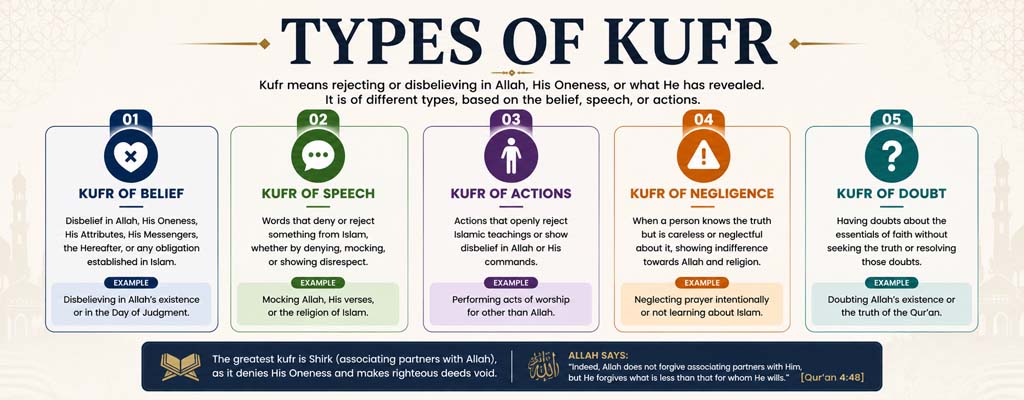
Types of Kufr in Islam
In Islamic theology, Kufr (Arabic: كُفْر) literally means “to cover” or “to conceal.” Islamically, it refers to the act of rejecting, denying, or disbelieving in Allah, His Messengers, or any of the fundamental pillars of faith that are established by the Quran and Sunnah.
Understanding the types of Kufr is essential for every Muslim, as it helps one:
* Protect their faith (Iman) from corruption.
* Recognize actions and beliefs that contradict Tawhid
* Understand Islamic theology (Aqeedah) more deeply.
* Avoid falling into major or minor disbelief.
Note: This is a scholarly educational topic. Classification of Kufr is a matter of Islamic jurisprudence discussed by classical scholars. No individual Muslim has the authority to declare another person a kafir (takfir) — this is a serious matter reserved for qualified scholars under strict conditions.
Primary Classification: Major vs Minor Kufr
Islamic scholars divide Kufr into two broad categories:
Type Arabic Term Effect on Faith
- Major Kufr Kufr Akbar Takes a person out of Islam entirely
- Minor Kufr Kufr Asghar Does not take one out of Islam but is a grave sin
The 5 Major Types of Kufr (Kufr Akbar)
Ibn al-Qayyim al-Jawziyyah (رحمه الله) outlined five major categories of Kufr in his landmark work Madarij al-Salikin. These are the most widely accepted classifications among Sunni scholars.
1. Kufr of Denial (Kufr al-Takdhib — كفر التكذيب)
Definition: To openly deny and reject the truth brought by the Prophet ﷺ with one’s heart and tongue.
Key Characteristics:
* Explicitly denying the Prophethood of Muhammad ﷺ
* Rejecting the truth of the Quran as the Word of Allah
* Denying the existence of Allah outright (atheism)
Quranic Evidence:
“And who is more unjust than one who invents a lie about Allah or denies the truth when it comes to him?” — (Quran 29:68)
2. Kufr of Arrogance and Pride (Kufr al-Istikbar — كفر الاستكبار)
Definition: Acknowledging the truth in one’s heart but refusing to submit to it out of arrogance.
Key Characteristics:
* Knowing Islam is the truth, but refusing to accept it out of pride.
* Considering oneself too superior to follow the commands of Allah
* The Kufr of Iblis (Satan) is the clearest example.
Example from the Quran:
“And [remember] when We said to the angels, ‘Prostrate before Adam’; so they prostrated, except for Iblis. He refused and was arrogant and became of the disbelievers.” — (Quran 2:34)
Key Point: Iblis knew the truth, but arrogance led to Kufr, showing that knowledge without submission is not Iman.
3. Kufr of Doubt (Kufr al-Shakk — كفر الشك)
Definition: To doubt or be uncertain about the fundamental tenets of Islam without striving to resolve that doubt.
Key Characteristics:
* Wavering between belief and disbelief regarding Allah’s existence
* Being uncertain about the authenticity of the Quran or Prophethood
* Treating Islamic fundamentals as debatable when they are definitively established
Quranic Evidence:
“And he entered his garden while he was unjust to himself. He said, ‘I do not think that this will perish — ever. And I do not think the Hour will occur…'” — (Quran 18:35–36)
4. Kufr of Turning Away (Kufr al-I’rad — كفر الإعراض)
Definition: To completely turn away from the truth — not learning it, not acting upon it, and not caring about it at all.
Key Characteristics:
* Willful ignorance of the religion despite having access to it
* Refusing to listen to or learn the message of Islam
* Complete indifference toward one’s obligations to Allah
Quranic Evidence:
“And who is more unjust than one who is reminded of the verses of his Lord; then he turns away from them?” — (Quran 18:57)
Scholarly Note: This type is particularly emphasized by Ibn Taymiyyah (رحمه الله), who noted that turning away from the truth without any justification is itself a form of rejection.
5. Kufr of Hypocrisy (Kufr al-Nifaq — كفر النفاق)
Definition: To outwardly profess Islam while inwardly disbelieving — a complete disconnection between the tongue and the heart.
Key Characteristics:
* Claiming to be Muslim publicly while having no belief internally
* Using Islam as a shield for worldly gain
* Being among the worst in the sight of Allah
Quranic Evidence:
“Indeed, the hypocrites will be in the lowest depths of the Fire — and never will you find for them a helper.” — (Quran 4:145)
Minor Kufr (Kufr Asghar) — Disbelief That Does Not Exit One from Islam
Minor Kufr refers to specific actions or statements described as “Kufr” in the texts, but which do not remove a person from the fold of Islam. They are, however, major sins that must be repented of.
Examples of Minor Kufr Include:
* Ungratefulness to one’s spouse — The Prophet ﷺ said: “I was shown Hellfire and most of its inhabitants were women who were ungrateful (kafarat)…” (Bukhari) — here “kafarat” refers to minor kufr
* Fighting a fellow Muslim — “Abusing a Muslim is sinful and fighting him is Kufr.” (Bukhari)
* Denying lineage — Claiming someone is not one’s father knowingly
* Wailing over the dead in a manner that implies rejecting Allah’s decree
Important: These are called Kufr in the texts due to their seriousness, but scholars unanimously agree they do not expel one from Islam unless paired with complete rejection in the heart.
Additional Categories Mentioned by Scholars
Some scholars further classify Kufr in relation to its object or manner:
Kufr in Actions (Kufr al-Amal)
* Committing an act that is inherently an act of disbelief
* Example: Prostrating to an idol while knowing it is worship
Kufr of Mockery (Kufr al-Istihza)
* Mocking Allah, His Messenger ﷺ, the Quran, or Islamic obligations
* Even if done “jokingly,” scholars consider this Major Kufr.
Quranic Evidence:
“Say: Was it Allah and His verses and His Messenger that you were mocking? Make no excuse; you have disbelieved after your belief.” — (Quran 9:65–66)
Kufr of Permitting the Forbidden (Kufr al-Istihlal)
* Declaring something halal that Allah has explicitly made haram, or vice versa
* Example: Believing alcohol or adultery is permissible
Summary Table: Types of Kufr at a Glance
# Type of Kufr Arabic Nature Effect
1 Denial Takdhib Denying the truth Major — exits Islam
2 Arrogance Istikbar Knowing truth, refusing to submit Major — exits Islam
3 Doubt Shakk Uncertainty about fundamentals Major — exits Islam
4 Turning Away I’rad Complete indifference to truth Major — exits Islam
5 Hypocrisy Nifaq Outward Islam, inner rejection Major — exits Islam
6 Minor Kufr Kufr Asghar Grave sins described as Kufr Does NOT exit Islam
7 Mockery Istihza Mocking religious matters Major — exits Islam
8 Permitting Haram Istihlal Legalizing what Allah forbade Major — exits Islam
The Ruling on Takfir (Declaring Someone a Kafir)
It is extremely dangerous and impermissible for ordinary Muslims to declare another Muslim a disbeliever (kafir). This is called Takfir, and scholars warn:
* Conditions and impediments must be rigorously verified.
* Only qualified Islamic scholars can address such matters.
* False Takfir has severe consequences for the one who makes it.
* The Prophet ﷺ said: “If a man says to his brother, O Kafir!’ then it returns to one of them.” (Bukhari & Muslim)
Frequently Asked Questions (FAQs)
Q: Is every sin considered Kufr? No. Sins are divided into major sins (Kaba’ir) and minor sins (Sagha’ir). Only specific acts explicitly described as Kufr in the texts fall under this category.
Q: Can a Muslim accidentally commit Kufr? Scholars note that Kufr generally requires knowledge and intent. However, certain statements of Kufr may take effect even without intent, according to some scholars, which is why Muslims should guard their tongues carefully.
Q: What should a person do if they fear they have fallen into Kufr? They should sincerely renew their Shahada, repent to Allah, and consult a knowledgeable Islamic scholar for guidance.
Summary
Understanding the types of Kufr is a fundamental aspect of Islamic Aqeedah (creed). The five major types — denial, arrogance, doubt, turning away, and hypocrisy — all share a common root: the rejection or concealment of truth in one’s heart. Minor Kufr, while serious, does not expel one from Islam.
Every Muslim must strive to strengthen their Iman, seek knowledge of their faith, and protect themselves from the causes of Kufr through:
* Consistent study of the Quran and authentic Sunnah
* Seeking knowledge from qualified scholars
* Regular remembrance of Allah (Dhikr)
* Sincere and consistent repentance (Tawbah)
May Allah protect us all from all forms of Kufr and keep our hearts firm upon Iman. Ameen.