
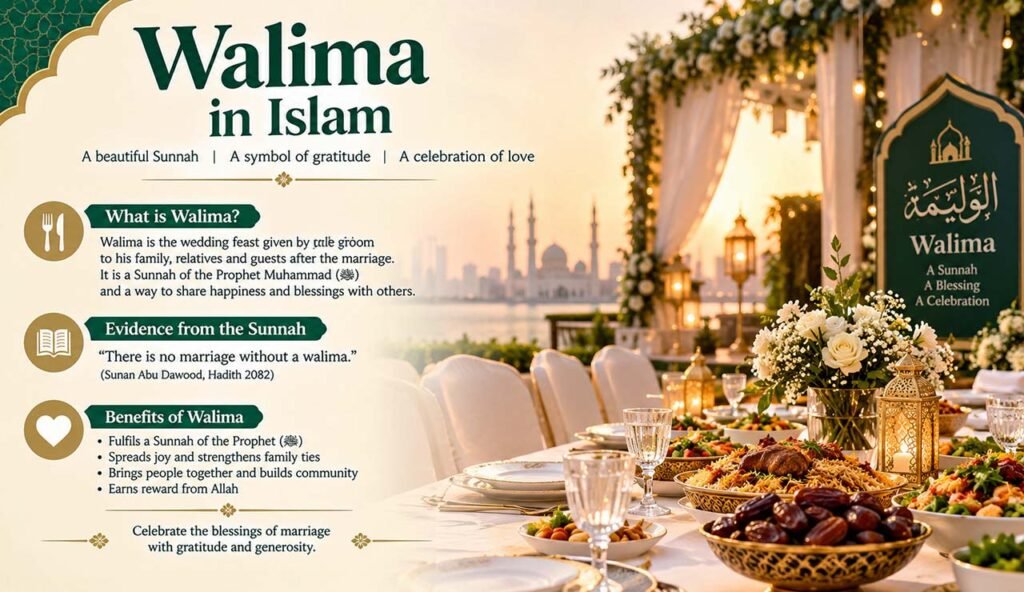
Is Walima Mandatory in Islam? Ruling, Evidence and Etiquette
The short answer is calmer than most people expect. In this article, we will look at what the Prophet (peace be upon him) did, what scholars have said, and how you can hold a walima that pleases Allah without breaking your budget.
What Is Walima?
Walima (also spelled valima) is the wedding feast that the groom hosts after marriage. Its purpose is simple. It announces the marriage, thanks Allah for His blessing, and lets family, friends, and neighbors share in the joy of the couple.
The word itself comes from an Arabic root linked to gathering. That fits well, because the heart of a walima is bringing people together over food.
Is Walima Mandatory? The Short Answer
Most scholars say walima is Sunnah Mu’akkadah. That means it is a strongly emphasized recommended act, not a condition for a valid marriage. If a couple does not hold one, the nikah is still fully valid.
That said, scholars have not all spoken with one voice. Some, including the Zahiri school and certain scholars within other schools, hold that walima is obligatory (wajib) because the Prophet commanded it. So the fair summary is this: the majority view is that it is strongly recommended, a minority view is that it is obligatory, and nobody says the marriage is invalid without it.
In practice, then, a Muslim should not treat walima casually. At the same time, nobody should go into debt to meet a standard that Islam never set.
Evidence for Walima from the Hadith
The ruling comes mainly from authentic reports in Sahih al-Bukhari and Sahih Muslim, in the chapters on marriage (Kitab al-Nikah).
The command to Abdur Rahman ibn Awf
When the Prophet (peace be upon him) noticed the trace of perfume on Abdur Rahman ibn Awf (may Allah be pleased with him) and learned he had just married, he made dua for him. Then he told him to hold a walima, even if it was only with one sheep. This command is the main reason some scholars lean toward obligation.
Notice the second half of that report too. “Even with a sheep” shows that the Prophet (peace be upon him) was asking for something within reach, not a lavish production.
The Prophet’s own walimas
The Prophet (peace be upon him) hosted walimas himself, and they varied a lot:
- For Zaynab bint Jahsh (may Allah be pleased with her), Anas ibn Malik reported that he fed the guests bread and meat until they were full.
- For some of his wives, he held a walima with just two mudd of barley, a very small amount.
- For Safiyyah (may Allah be pleased with her), the meal was made of dates, cheese, and ghee, laid out on a leather mat.
The lesson is clear. The Sunnah is the act of feeding people for the marriage, not a particular menu or size.
What the Scholars Say About the Ruling
Here is a simple overview. Details can differ between schools and between individual scholars, so if you want a ruling for your specific situation, ask a trusted local scholar.
- Majority view: Walima is Sunnah Mu’akkadah, which means a stressed, highly recommended act.
- Minority view: Walima is wajib, based on the Prophet’s direct command to Abdur Rahman ibn Awf.
- Agreed by all: The nikah is valid whether or not a walima takes place.
It also matters that the command is tied to the means of the groom. Allah does not burden a soul beyond its capacity (Quran 2:286). So a husband who truly cannot afford much can offer something small, even a modest meal shared with a few people.
Is It Mandatory to Attend a Walima?
This is a separate question, and it is where the wording of the hadith is strongest. The Prophet (peace be upon him) said that when one of you is invited to a walima, he should go. He also warned about a walima where only the wealthy are invited and the poor are left out, and said that whoever refuses the invitation has disobeyed Allah and His Messenger.
Because of these reports, many scholars say accepting a walima invitation is obligatory, as long as certain conditions are met. Others say it is a strongly recommended act. Either way, the safe and kind path is to attend if you can.
When you may decline
Scholars generally allow a person to excuse himself when:
- there is something forbidden at the event, such as alcohol or open sinful behavior that he cannot stop;
- he is ill, traveling, or has a real hardship;
- attending would cause harm, or the invitation is meant to show off or to exclude the poor;
- the host is known for earning in clearly unlawful ways, according to some scholars.
What if you are fasting?
The Prophet (peace be upon him) taught that a fasting guest should still come and make dua for the hosts. If the fast is voluntary, he may break it or continue it. This is a gentle rule that protects the host’s feelings.
When Should the Walima Be Held?
Scholars differ on timing. Some prefer it after the marriage is consummated, and others say it can be held at the time of the nikah or soon after. All of these are acceptable. What matters is that it is connected to the marriage and held without delay or hardship. There is flexibility here, so choose the time that works best for both families.
Does Walima Have to Be Big or Expensive?
No. In fact, Islam warns against the opposite. Allah says: “Eat and drink, but do not be excessive. Indeed, He does not like those who commit excess” (Quran 7:31).
The Prophet’s own walimas, from barley to a sheep, show that the standard is generosity within your means. A walima that leaves the couple in debt, or that is mainly about impressing others, works against the spirit of the Sunnah.
Walima Etiquette for the Host
- Keep your intention clean. Host to follow the Sunnah and share the blessing, not to compete.
- Invite widely and fairly. Include relatives, neighbors, the righteous, and the poor, not only the rich or influential.
- Avoid waste. Plan quantities sensibly, and share leftovers with those in need.
- Keep the gathering clean. Avoid anything Allah has forbidden, so that guests can attend with a clear conscience.
- Be grateful. Start with praise of Allah and end with sincere thanks to your guests.
Walima Etiquette for the Guest
- Reply honestly and arrive on time.
- Make dua for the couple. A classic one is: Barakallahu laka wa baraka alayka wa jama’a baynakuma fi khayr (“May Allah bless you, shower His blessings upon you, and unite you both in goodness”).
- Eat what is offered without complaint, and do not take more than you need.
- Leave things better than you found them, and avoid gossip.
[INTERNAL LINK: dua for newly married couples]
Common Misunderstandings
“The bride’s family must pay.” Not so. In the Sunnah, the walima is the husband’s responsibility.
“A bigger walima is more rewarding.” The reward lies in sincerity and following the Sunnah, not in the number of guests or dishes.
“Without a walima, the marriage is incomplete.” The marriage is valid. Walima is a recommended act that follows it.
Frequently Asked Questions
Is a nikah valid without a walima?
Yes. A nikah is valid when its conditions are met, such as consent, the guardian, witnesses, and the mahr. Walima is a recommended act after marriage, not a condition for its validity.
Who is responsible for hosting the walima?
The groom. The Sunnah places it on the husband according to his means. The bride’s family is not required to host it.
Does a walima have to be expensive or large?
No. The Prophet (peace be upon him) held walimas that ranged from simple barley to a sheep. Islam discourages extravagance and showing off.
Is it compulsory to attend a walima if invited?
Many scholars say accepting is obligatory when there is no valid excuse and nothing forbidden at the event. Others view it as strongly recommended. A fasting guest should still attend and make dua.
Summary
So, is walima mandatory? For most scholars, it is a strongly emphasized Sunnah, and for some it is an obligation. In every view, the marriage stands valid without it. What Islam asks for is simple: thank Allah, share food, include others, and keep it within your means.
If you are planning a walima, start with a small, sincere gathering and let the barakah do the rest. And if you are unsure about a detail, ask a qualified scholar. Allah knows best.
May Allah bless every married couple and unite them in goodness. Ameen.