
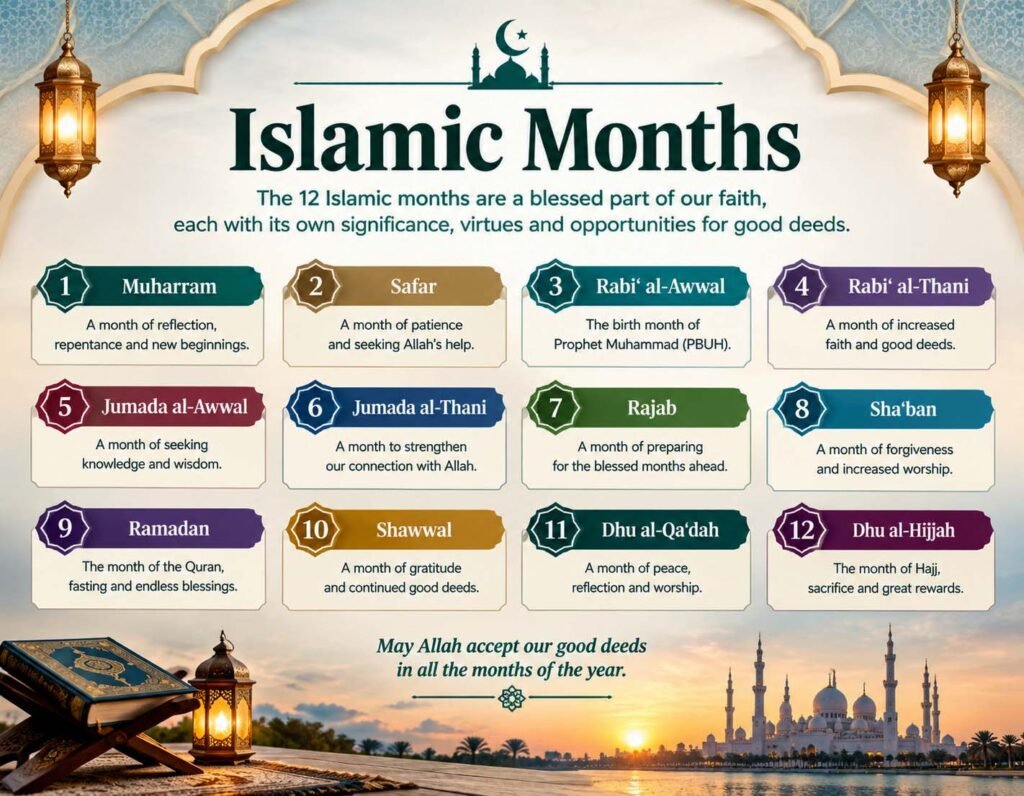
Islamic Months: Names, Order, Meanings and Significance
What Is the Islamic (Hijri) Calendar?
The Islamic calendar, also called the Hijri calendar, is a purely lunar calendar. Its years are counted from the Hijrah, the Prophet Muhammad’s ﷺ migration from Makkah to Madinah in 622 CE. That is why you will often see dates written with “AH,” which stands for Anno Hegirae, or “after Hijrah.”
Interestingly, the calendar was not formally introduced during the Prophet’s ﷺ lifetime. It was adopted during the caliphate of Umar ibn al-Khattab (may Allah be pleased with him), around 17 AH. The companions agreed that the Hijrah was the right starting point, because it marked the moment the Muslim community was truly established.
The months themselves, however, are far older than that. The Quran refers to the divine count of months as something fixed since the creation of the heavens and the earth.
How Many Islamic Months Are There?
There are 12 Islamic months in every Hijri year. Allah says in Surah At-Tawbah (9:36) that the number of months with Him is twelve, and that four of them are sacred. You can read the verse with its translation on Quran.com.
Each month lasts either 29 or 30 days, depending on when the new moon is sighted. This gives a lunar year of about 354 or 355 days.
The 12 Islamic Months in Order
Here is a quick overview before we look at each month in detail. The meanings listed are the commonly cited linguistic roots; scholars sometimes mention more than one explanation.
| # | Month | Arabic | Common Meaning | Best Known For |
|---|---|---|---|---|
| 1 | Muharram | مُحَرَّم | Forbidden, sacred | Islamic New Year, Ashura |
| 2 | Safar | صَفَر | Empty, yellow | Rejecting superstition |
| 3 | Rabi’ al-Awwal | رَبِيع الأَوَّل | First spring | Birth of the Prophet ﷺ, Hijrah arrival in Madinah |
| 4 | Rabi’ al-Thani | رَبِيع الثَّانِي | Second spring | Also called Rabi’ al-Akhir |
| 5 | Jumada al-Awwal | جُمَادَى الأُولَى | First of dryness | Regular worship and reflection |
| 6 | Jumada al-Thani | جُمَادَى الآخِرَة | Second of dryness | Also called Jumada al-Akhirah |
| 7 | Rajab | رَجَب | To revere, to honour | Sacred month, Isra and Mi’raj |
| 8 | Sha’ban | شَعْبَان | To spread out, disperse | Preparation for Ramadan |
| 9 | Ramadan | رَمَضَان | Scorching heat | Fasting, Quran, Laylat al-Qadr |
| 10 | Shawwal | شَوَّال | To lift, to raise | Eid al-Fitr, six days of fasting |
| 11 | Dhul Qa’dah | ذُو القَعْدَة | The one of rest or truce | Sacred month, Umrah of the Prophet ﷺ |
| 12 | Dhul Hijjah | ذُو الحِجَّة | The one of pilgrimage | Hajj, Day of Arafah, Eid al-Adha |
The Four Sacred Months in Islam
Four of the Islamic months are called the sacred months, or al-ashhur al-hurum. These are Dhul Qa’dah, Dhul Hijjah, Muharram and Rajab. The first three come one after another, while Rajab stands alone, between Jumada al-Thani and Sha’ban.
The Prophet ﷺ confirmed this arrangement in his Farewell Pilgrimage sermon. It is recorded in Sahih al-Bukhari.
Why does this matter? In these months, wrongdoing is considered even more serious, and righteous deeds carry extra weight. Before Islam, Arab tribes also respected these months as a time of truce. Islam kept that respect and made it part of its teachings. Allah warns believers in the same verse not to wrong themselves during these months.
Islamic Months Explained One by One
1. Muharram
Muharram opens the Hijri year, and its name means “forbidden,” pointing to its sacred status. The Prophet ﷺ called it “Allah’s month” and said that the best fasting after Ramadan is fasting in Muharram (Sahih Muslim).
The most famous day is Ashura, the 10th of Muharram. On this day, Allah saved Prophet Musa (Moses) and his people from Pharaoh. The Prophet ﷺ fasted it and encouraged Muslims to do the same. He also wished to fast the 9th alongside it, so many Muslims fast both days.
2. Safar
Some people wrongly treat Safar as an unlucky month. Islam rejects this idea completely. The Prophet ﷺ taught that there is no bad omen in the way people believed in pre-Islamic times (Sahih al-Bukhari).
Safar is simply another month of Allah’s creation. Marriages, travel, business and worship are all perfectly fine in it. In fact, it teaches a useful lesson: our fortune never depends on a date on the calendar.
3. Rabi’ al-Awwal
Rabi’ al-Awwal is the month in which the Prophet Muhammad ﷺ was born, and the month in which he arrived in Madinah after the Hijrah. Both events changed history. Many scholars mention the 12th as the date of birth, though historians have noted other opinions.
Muslims hold different views on how to mark this month. What everyone agrees on is the real purpose: to study the Seerah, follow the Sunnah, and increase our love for the Prophet ﷺ through action.
4. Rabi’ al-Thani
Rabi’ al-Thani, also known as Rabi’ al-Akhir, means “the second spring.” It carries no special rulings of its own. Still, an ordinary month is never wasted for a believer.
Use it to build steady habits, such as daily Quran recitation, morning and evening adhkar, and regular charity. Consistent small deeds are beloved to Allah, as the Prophet ﷺ taught.
5. Jumada al-Awwal
The name Jumada is linked to dryness or frozen water, reflecting the season in which the months were first named. Since the calendar is lunar, the months no longer line up with those seasons.
No special acts are tied to this month. It is a good time to review your goals, repay debts, and strengthen family ties before the more blessed months approach.
6. Jumada al-Thani
Jumada al-Thani, also called Jumada al-Akhirah, is the last month before Rajab. It is a quiet stretch on the calendar, and that makes it ideal for preparation.
Many Muslims use these weeks to plan ahead. They set a target for Quran reading, decide on voluntary fasts, and begin to build the energy they will need for Ramadan.
7. Rajab
Rajab is the seventh month and one of the four sacred months. Its name comes from a word meaning “to honour,” because Arabs long respected it by pausing conflict.
Many Muslims connect Rajab with the night journey of Isra and Mi’raj. However, scholars differ about the exact date, and there is no authentic text fixing it in this month. For the same reason, scholars advise caution: many hadiths about special prayers or fasts in Rajab are weak or fabricated. The safest path is to increase the worship that is already established, such as voluntary fasting, dhikr and istighfar.
8. Sha’ban
Sha’ban sits right before Ramadan, and the Prophet ﷺ gave it special attention. His wife Aisha (may Allah be pleased with her) reported that she never saw him fast more in any month than in Sha’ban (Sahih al-Bukhari).
He ﷺ explained that people often neglect this month, even though deeds are raised to Allah in it. Think of Sha’ban as a training camp. Fasting a few extra days now makes Ramadan feel much easier.
9. Ramadan
Ramadan is the holiest month of the year and the ninth of the Islamic months. Allah revealed the Quran in it, as stated in Surah Al-Baqarah (2:185). Fasting from dawn to sunset is one of the five pillars of Islam.
The last ten nights hold Laylat al-Qadr, the Night of Decree. Allah describes it as better than a thousand months (Quran 97:3). Because of this, Muslims increase their prayer, recitation and dua in the final nights.
10. Shawwal
Shawwal begins with Eid al-Fitr, the day of celebration after a month of fasting. It is a time for gratitude, family gatherings and sharing joy with the poor through Zakat al-Fitr, which must be given before the Eid prayer.
The Prophet ﷺ also encouraged fasting six days in Shawwal. He said that whoever fasts Ramadan and follows it with six days of Shawwal is like one who fasted the whole year (Sahih Muslim).
11. Dhul Qa’dah
Dhul Qa’dah is the first of the three consecutive sacred months. Arabs used to rest from fighting and travel peacefully in it, which is how it earned its name. It is also one of the Hajj months mentioned in the Quran (2:197).
The Prophet ﷺ performed several Umrahs in this month. If you are planning Umrah or Hajj, this is often when preparations begin, from booking and paperwork to learning the rituals.
12. Dhul Hijjah
Dhul Hijjah closes the Islamic year and hosts the Hajj. Millions of pilgrims gather in Makkah, and the rites of Hajj are completed between the 8th and 13th days. The Prophet ﷺ said no days are better for righteous deeds than the first ten days of this month (Sahih al-Bukhari).
Two days stand out. Fasting on the Day of Arafah, the 9th, is highly recommended for those who are not performing Hajj, and it expiates the sins of the previous and coming year (Sahih Muslim). The 10th brings Eid al-Adha, which honours the sacrifice of Prophet Ibrahim (Abraham) and his son.
How Do the Islamic Months Begin?
Each month starts with the sighting of the new crescent moon, or hilal. On the 29th day, Muslims look for the crescent after sunset. If it appears, the new month begins. If clouds hide it, the current month completes 30 days.
The Prophet ﷺ gave this instruction clearly. He told us to fast when we see the crescent, and to end the fast when we see it again. If the sky is cloudy, we complete the count of 30 days.
Because of this, the first day of a month can differ slightly between regions. Many countries, including the UAE, rely on official moon-sighting committees to announce the start of each month, especially for Ramadan and the two Eids.
One more detail is worth knowing. An Islamic day begins at sunset, not at midnight. That explains why Muslims start Ramadan fasting the morning after the crescent is sighted, and why the “night” before a date belongs to that date.
Why Do the Islamic Months Move Through the Seasons?
A lunar year is about 10 to 11 days shorter than a solar year. As a result, every Islamic month arrives roughly 10 to 11 days earlier on the Gregorian calendar each year.
Over about 33 years, Ramadan travels through every season. A Muslim may fast long summer days in one decade and short winter days in another. Many see wisdom in this, because it shares both the ease and the challenge of fasting fairly among believers around the world.
Allah points to the moon’s role in time-keeping in the Quran. In Surah Al-Baqarah (2:189), He says the new moons are markers of time for people and for Hajj.
How to Benefit From Every Islamic Month
Knowing the months is useful. Living by them is better. Here are some simple ways to start:
- Learn the order. Say the 12 names aloud a few times until they feel natural, and teach them to your children.
- Use a Hijri calendar. Keep one on your phone or wall so that fasting days and key dates never surprise you.
- Plan your voluntary fasts. Mark Muharram, Sha’ban, Shawwal and Dhul Hijjah in particular, along with the white days (13th, 14th and 15th) of each month.
- Prepare early for Ramadan. Begin building habits in Rajab and Sha’ban rather than waiting for the crescent.
- Stay with authentic worship. Prefer acts supported by the Quran and authentic Sunnah over unverified practices.
Frequently Asked Questions About Islamic Months
How many Islamic months are there?
There are 12 Islamic months in a Hijri year. Each lasts 29 or 30 days, so the year totals about 354 or 355 days.
What is the first month of the Islamic calendar?
Muharram is the first month. Its first day marks the Islamic New Year.
Which are the four sacred months in Islam?
They are Dhul Qa’dah, Dhul Hijjah, Muharram and Rajab. Wrongdoing is especially forbidden in them, and good deeds carry extra weight.
Which is the holiest month in Islam?
Ramadan is widely regarded as the holiest month. The Quran was revealed in it, and it contains Laylat al-Qadr, which is better than a thousand months.
Why does Ramadan come earlier every year?
The Islamic calendar is lunar, so each year is about 10 to 11 days shorter than the Gregorian year. Every month, including Ramadan, therefore shifts earlier each year.
Summary
The Islamic months are more than names on a calendar. They connect us to the Quran, the life of the Prophet ﷺ, and the rhythm of worship that has guided Muslims for centuries. From the reflection of Muharram to the sacrifice of Dhul Hijjah, each month offers a fresh chance to draw closer to Allah.
Start with one small step. Learn the order of the months, pick one voluntary fast to keep, and let the calendar remind you of what truly matters. May Allah help us make the most of every month He has given us.